You finally go to buy the .com to match your .ca, or a customer tells you they typed your name with the wrong ending and landed on someone else's page. Someone registered a domain with your business name, and your first thought is "they stole it". Sometimes that's true. Much more often it's a company in another province with the same name, or a domain seller who got there in 2006. This morning I looked up the .ca and .com twin of 24 sites I build or look after, so this guide starts from what the registry actually shows, not from a scary story.
Can you get the domain back?
Usually only if your name was in use before they registered it, and they took it in bad faith, for example to sell it to you or to pose as you. If they registered first, a dispute is almost always closed, and your real choices are buying it, waiting for it to expire, or living with your own ending.
Date 2 earlier than date 1 opens the dispute door. Date 1 earlier closes it in nearly every case.
I'm a web designer, not a lawyer, so treat what follows as the map, not the court order. The rules I quote are the actual dispute policies for .ca and .com, read today, with the current fees.
Three facts to find before you email anyone
Don't contact the holder yet. A message that says "I really need this domain" has added a zero to many prices. Collect these three first.
- When it was registered
- For a .com, type the domain into ICANN Lookup. For a .ca, use the lookup on CIRA's site. Both show the creation date, the expiry date and the registrar, which is the company the domain is rented through.
- Who holds it
- Often hidden. Most .com records show a privacy service, and a .ca owned by a person shows no name at all. For those, CIRA's lookup offers a form that forwards your message to the owner. They don't have to answer.
- What it shows today
- Open it in a private window, and on a phone. Write down what you see and take a screenshot with the date. That screenshot is evidence if this ever turns into a dispute, and the page can change tomorrow.
What the address shows decides your move
The same registration can be harmless or urgent, depending on what's sitting on it. This is how I sort it for a client.
| What you see | What it usually means | What I'd do |
|---|---|---|
| "This domain is for sale" | A domain investor holds it and waits for someone like you | Check the date, then decide if it's worth a price. Never pay through a plain bank transfer |
| Another company's real website | A namesake with its own customers, often in another city or trade | Leave it. Make your own domain clear in your Google profile, signs and email |
| A blank page or a builder's error page | Registered and never finished, sometimes by a person who forgot about it | Note the expiry date and watch it. A polite message can work here |
| Ads or links to your competitors | Someone earns from people who mistype your name | Collect screenshots. This is the case the dispute rules were written for |
| A copy of your site, or email in your name | Fraud in progress | Warn customers today, report it to the registrar's abuse address, then think about a dispute |
The last row is the only real emergency. If customers are getting invoices from an address that looks like yours, stop reading this and open my guide on what to do when a customer paid a fake invoice. If someone copied your pages word for word, the takedown steps are in someone copied my website.
I checked the twins of 24 real business sites
Most twins were free, and none of the taken ones was a fake. For each site I look after, I took its other ending: the .com of a .ca site, the .ca of a .com site, and both for a .us site. That's 26 twin domains. I read each one's public registry record this morning and opened the home page of every taken one.
The six taken twins, with the year each was registered and what it shows today:
- 2000
Another company's live website, in a different trade. - 2000
Another company's live website, with the same two words in its name. - 2000
Sends visitors to a manufacturer's site in another country. - 2012
A "for sale, premium domain" page at a big registrar. - 2024
A blank page with no text at all. - 2024
A website builder's "connect your domain" error page.
Two things stood out. First, for all 5 sites where the registry gave me a date for our own domain, the twin was older. Not one of these was "someone grabbed my name after I got famous". They simply got there first. Second, 20 of 26 twins are still free. Registering one costs about what a lunch for two costs, and none of these businesses has had a reason to, until the day one of them needs it.
Read on 28 November 2026 from the public RDAP records of the .ca and .com registries, then one plain request to each taken home page. No owner data was collected. The sites belong to small businesses in Ontario and the US; I don't name them or their twins.
The dispute route: what the .ca and .com rules ask for
Both endings have a dispute process that's cheaper and faster than court, and both ask you to prove three things. The details differ, and the date question is where most owners stop.
A .ca domain (CIRA's CDRP)
- Your mark, including a trade name you used in Canada, must be the same as or confusingly similar to the domain.
- Your rights must come before their registration date.
- They registered it in bad faith, and have no legitimate interest in it.
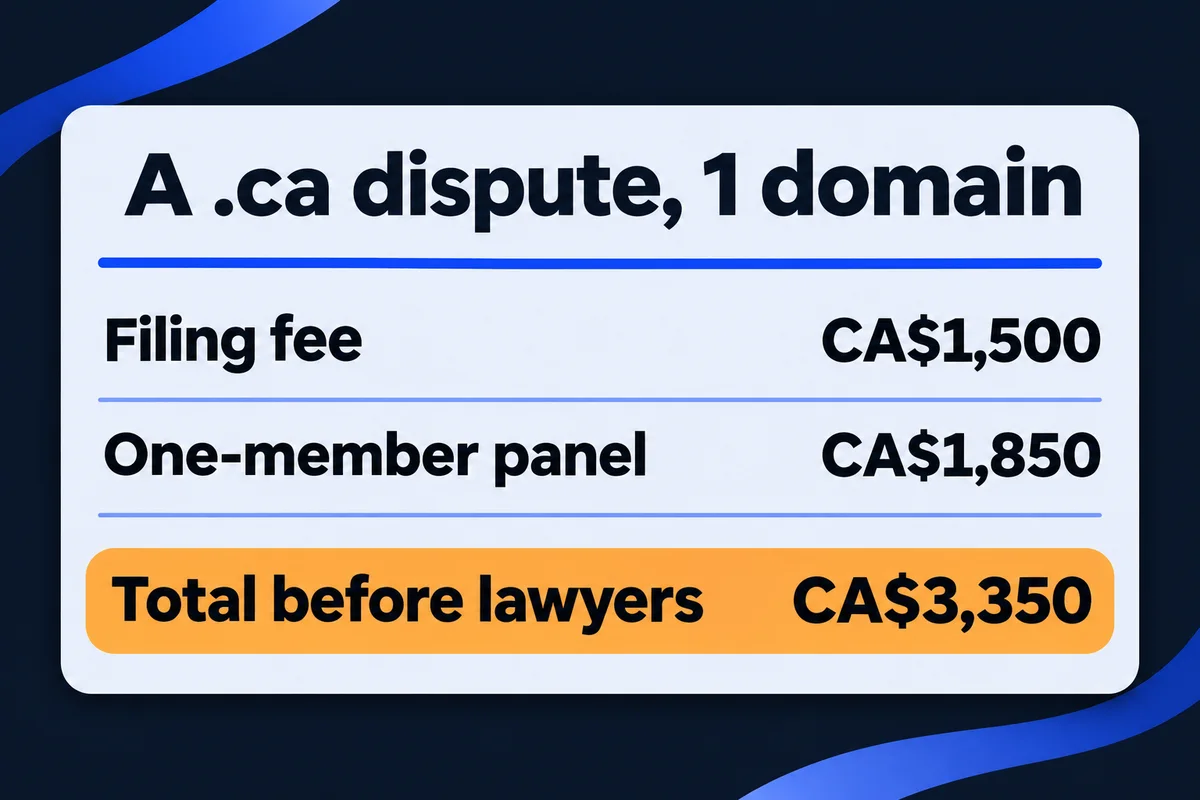
- Cost at CIIDRC for 1 or 2 domains: CA$1,500 to file plus CA$1,850 for one panelist or CA$3,000 for three.
- If you win, the domain is deleted or transferred to you.
A .com domain (ICANN's UDRP)
- The domain is identical or confusingly similar to a trademark or service mark you have rights in.
- The holder has no rights or legitimate interests in it.
- It was registered and is being used in bad faith.
- Cost at WIPO for 1 to 5 domains with one panelist: US$1,500.
- A win means the domain is cancelled or transferred.
"Bad faith" has a fairly short meaning in both policies: registering mainly to sell to you or your competitor for more than it cost, blocking you as part of a pattern, disrupting a competitor, or pulling your customers to their site by making it look like yours. A namesake running its own business doesn't fit any of these. The CIRA policy even lists a person's own legal name and a plain description of their business as legitimate interests.
"the Registrant's dot-ca domain name is Confusingly Similar to a Mark in which the Complainant had Rights prior to the date of registration of the domain name and continues to have such Rights"CIRA Domain Name Dispute Resolution Policy, paragraph 4.1
That's why the date check comes first. If your rights are younger than their registration, the filing fee buys you a well-written "no". When your dates and the evidence line up, a trademark lawyer who does these cases is worth the call, and the fees above are on top of what they charge.
Buying the domain without paying the panic price
When the holder registered first and the page says it's for sale, buying is usually cheaper than any fight. A .ca dispute starts at CA$3,350 in fees before anyone writes a word, so that's the ceiling I compare every price with.
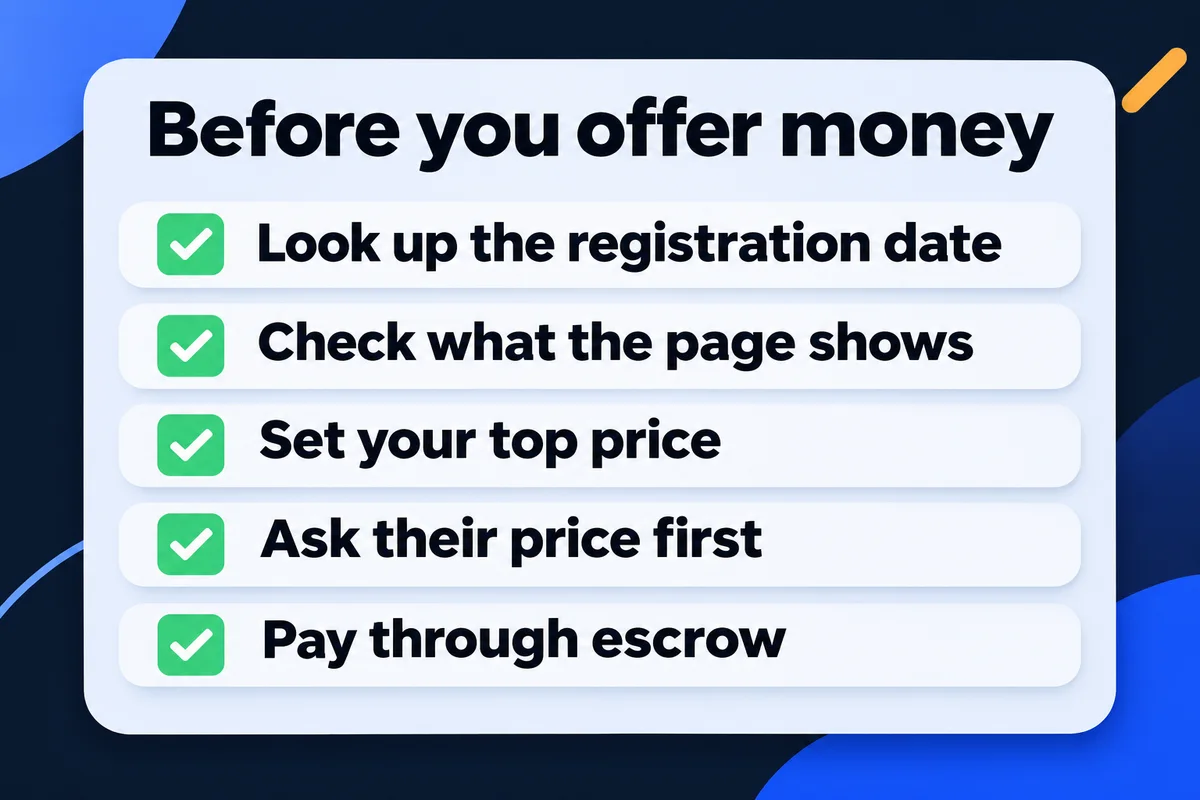
- Decide what it's worth to you before you ask. How many people really type the other ending? If your customers find you through Google and your Google profile, the answer is often "not many".
- Ask for their price. Don't name yours first, don't mention your business, and send it from a plain address, not your company email.
- Pay only through a domain escrow service or the marketplace on the "for sale" page, so the domain moves to your account before the money moves to theirs.
- When it arrives, point it to your real site with one redirect and renew it for several years.
A first message that gives nothing away, with a made-up name:
Or wait for it to drop
Every registration has an expiry date in the same public record. A domain that's blank or broken may simply not be renewed. Write the date in your calendar a month before, and check again on the day. When a domain does lapse, the registry gives the old holder a grace period first, so it doesn't become free on the morning it expires. My guide on what happens when a domain expires walks through those stages from the other side.
Register your twins before someone else does
The cheapest dispute is the one you never need. Grab the other ending of your name, and the obvious misspelling if your name has one, then point them all to your main site. A year of a twin costs less than one hour of anyone's legal time.
Put every domain in your own name, on your own registrar account, with auto-renew on. A domain held in a former web person's account is one email away from being lost. My guide on choosing a domain name you won't regret covers .ca versus .com and the renewal-price trap, and who owns your website covers getting the account into your hands. If you'd rather someone else watched the renewals, records and redirects, that's part of my website maintenance and support plan.
Questions about a domain with your business name
Is it illegal for someone to register a domain with my business name?+
Registering a name that is free is normal, and a business with the same or a similar name has every right to it. It becomes a problem when the domain was taken in bad faith, for example to sell it to you or to pass itself off as you. That is what the .ca and .com dispute rules deal with.
How much does a .ca domain dispute cost?+
At CIIDRC, one of the providers CIRA approves, a complaint about one or two .ca domains costs a CA$1,500 filing fee plus CA$1,850 for a one-member panel, or CA$3,000 for a three-member panel, under fees in effect since 1 September 2026. The person who files pays all of it. Legal help is extra.
Can I win a dispute if they registered the domain before I started my business?+
Under the CIRA policy, your rights in the name must come before the date the other domain was registered. If they registered first, the dispute route is usually closed, and buying the domain or waiting for it to expire is what is left.
Should I just buy the domain?+
If the holder registered first and is selling, buying is often the cheapest way out, because a dispute starts at about CA$3,350 in fees for a .ca. Find out what the domain is worth to you in customers first, and pay through an escrow service, never by a plain transfer to a stranger.
How do I find out who owns a domain with my name?+
For a .com, type it into ICANN Lookup. For a .ca, use the lookup on CIRA's site. Both show the registration and expiry dates and the registrar. The owner's name is often hidden for privacy, and for a .ca owned by a person CIRA offers a form that passes your message on.
Sources, read on 28 November 2026: CIRA Domain Name Dispute Resolution Policy (paragraphs 3.4, 3.5, 4.1 and 4.3, as published by CIIDRC), CDRP fee schedule (CIIDRC, fees from 1 September 2026), Uniform Domain Name Dispute Resolution Policy (ICANN, paragraph 4) and Schedule of fees under the UDRP (WIPO). The twin domain counts come from my own registry lookup the same morning. The sample message uses a made-up name.
Found your name on someone else's domain?
Send me both addresses. I'll pull the registry dates, look at what each one shows, and tell you which row of the table you're in.
Get My Free Quote
I build and look after websites for small businesses around the GTA, and I keep their domains renewed in their own names. Read my full bio · Get in touch