Roofing website cost is the one quote where a roofer gets to feel what their customers feel: three prices for the same job and no idea which one to believe. So this morning I read the sitemaps of 15 real Ontario roofing companies and counted what they hold. Then I held those counts up against my own price list, in Canadian dollars, so you get a number and not a mood.
How much does a roofing website cost in Ontario?
On my price list it's $899 CAD for up to 10 pages, $1,499 for up to 20 and $2,999 with no page limit, each paid once. Add about $100 to $200 a year for the domain and hosting. The page count decides which line applies to you, so I went and counted real ones.
Each bar below is one roofer's website, with blog posts taken out. I've left the names off because this is about the sizes and nobody here asked to be in an article.
Would fit the $899 line: up to 10 pages
- 2
- 6
Would fit the $1,499 line: 11 to 20 pages
- 11
- 11
- 17
- 19
Would need the $2,999 line: more than 20 pages
- 27
- 38
- 47
- 55
- 60
- 68
- 109
- 148
- 972
Few addresses naming a place 30 or more addresses naming a place. The last bar runs off my scale, or the other 14 would be specks.
The median is 38 pages. That number flatters nobody, because it hides two different kinds of roofing website, and the next section pulls them apart.
How I got the sample, so you can judge it. I took roofing company names from Ontario directories and tried 48 web addresses. Sixteen answered as Ontario roofers, 15 of those had a sitemap with something in it, and one had an empty sitemap, so I left it out of the counts. That makes it a handful of real sites, not a census. Four sitemaps don't separate posts from pages, so on those I removed only what sits under a blog address, which means those counts can run high.
Why are some roofing sites ten times bigger than others?
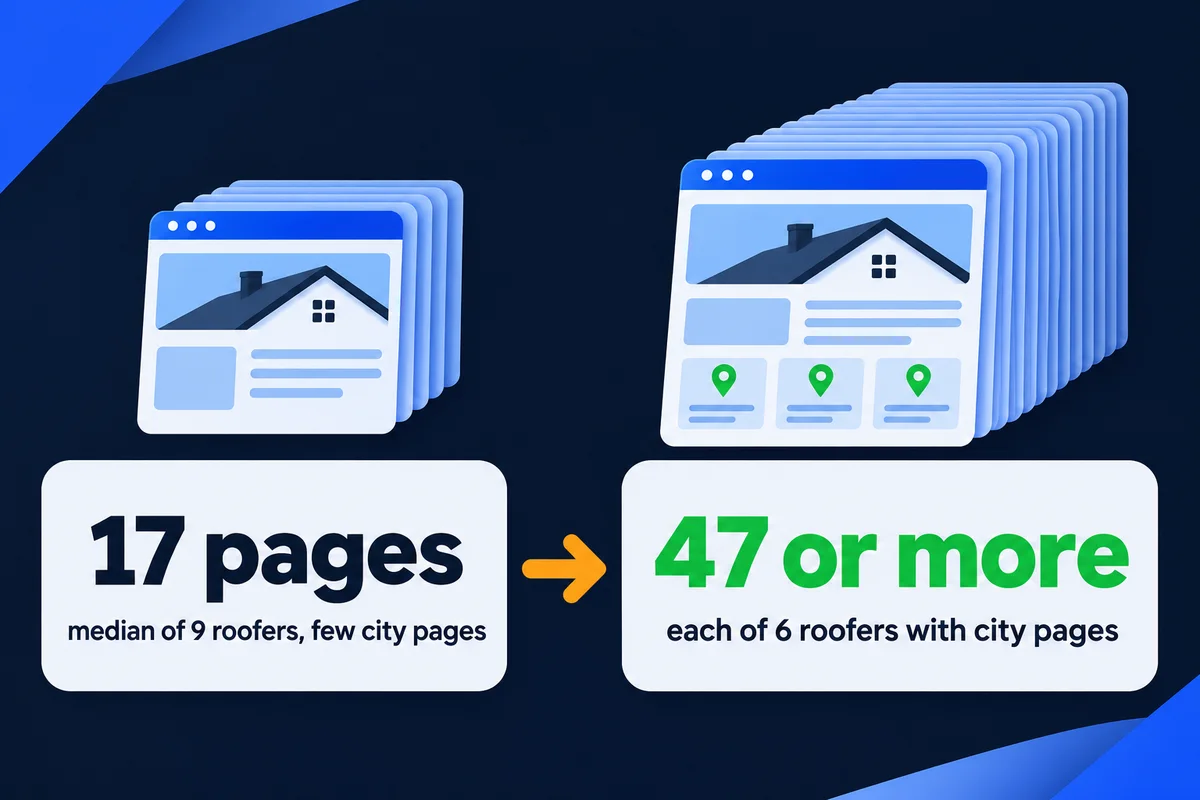
City pages, mostly. Nine of the 15 sites have almost no addresses naming a place, and their median is 17 pages. The other six each hold 30 or more such addresses, and the smallest of those has 47 pages. Your services add a handful of pages. Your list of towns adds dozens.
Nine sites without city pages
17Median pages. They run from 2 to 60, with the home page, the roof types, a gallery and a contact page making up most of it.
Six sites with city pages
47+Pages on the smallest of them. The largest has 972, which is more pages than any crew could visit in a season.
Blogs are the other thing that swells a sitemap, and they sit outside the bars above. Four of these companies carry 48 or more posts, and one has 136 posts sitting on just 17 pages. If you're wondering whether you need that on day one, whether a small business needs a blog at all is a separate question, and you can answer it after the phone starts ringing.
Do I need a separate page for every city I work in?
No. Write one when you have something true to say about that town: jobs you've done there, the kind of houses, how far your crew drives. A page with the town's name swapped in costs you money to build and gives a reader nothing, and Google's spam policy lists pages like that as an example of what it acts against.
"Having multiple domain names or pages targeted at specific regions or cities"
An example of doorway abuse in Google's spam policies for web search
Read the whole policy and you'll see it's aimed at pages built to catch a search and funnel people elsewhere, so a useful page about a town you really serve is a different thing. Local SEO for a service business also leans on your Google profile and your distance from the searcher, and no quantity of pages moves your yard closer to Oshawa.
I wanted to see how far these pages differ in practice. On five of the six sites I could read two city pages, masked the town names and measured how much wording the two share, in runs of eight words.
Each column is one company. Some page furniture stays in the count, and the two pages I compared don't always cover the same service, so treat these as rough readings.
I'm not calling anyone a spammer on the strength of a word count. It does show the range, though: one company's two pages have almost nothing in common, and another's share about half their wording. Here's the test I'd run on each town before paying for its page:
- You have photos of a job you did there.
- You'd send a truck there for a small leak next week.
- You can say one true thing that wouldn't fit the next town's page.
- Somebody on your crew could name a street or a neighbourhood without opening a map.
Count your own quote before you ask for one
You can work out most of a roofing website's price on the back of an invoice. Here's the sum for a made-up company doing shingles, flat roofs and repairs around three towns, using the page limits from my pricing page.
- Home, about, contact and a gallery of real jobs4
- Shingle roofs, flat roofs, leak repair, full replacement, eavestroughs5
- Insurance claims, in your own words1
- Towns that pass the test above3
- Total, which lands on the $1,499 line13
Now the first year in full. These three are examples I worked out for this article and not clients, and the domain and hosting go to your registrar and host in your own name. If a checkout tries to turn that line into $400, the hosting cart has a few tricks you can untick.
One crew, one town
8 pages
- Website
- $899
- Google Maps setup
- $149
- Domain and hosting
- $100 to $200
- First year
- $1,148 to $1,248
Three or four towns
18 pages, with a blog section
- Website
- $1,499
- Maps setup and optimization
- $299
- Domain and hosting
- $100 to $200
- First year
- $1,898 to $1,998
A whole region
30 pages or more
- Website
- $2,999
- Maps setup and optimization
- $299
- Domain and hosting
- $100 to $200
- First year
- $3,398 to $3,498
The rest is monthly, you can start or stop it in any month, and a website runs without it: support at $100, Google Maps management from $149, SEO from $300. Text and photos are free when you supply them, and if you'd like me to write the text, that's quoted before you commit. My websites for roofing companies page shows how the leak call and the replacement quote take different paths through a site like this, using the two roofing sites I've built so far.
What 16 roofers put on their home pages, and what it takes
I also read the home page text of all 16 for the things roofers like to mention. Most of this list costs an afternoon of your time and no money, which is good news if you've just been quoted for "trust signals". It's a simple word check, so read each count as a floor.
| On the home page | Of 16 | What it takes |
|---|---|---|
| A phone number you can tap | 16 | One line of code, and the only item here nobody skipped |
| Warranty | 14 | Your terms, in a sentence you'd repeat to a homeowner |
| A form | 13 | Installed on every plan I sell |
| Gallery or "our work" | 12 | One page and your own photos from your phone's camera roll |
| WSIB | 8 | A sentence, and see the note below |
| Emergency service | 7 | A sentence if you really answer at night |
| Insurance claims | 5 | One page, because homeowners have the same few questions |
| Financing | 5 | A sentence and a link, if your lender offers one |
Why I'd skip the date on a WSIB line
A clearance from the Workplace Safety and Insurance Board is valid for up to 90 days. Print a certificate date on your site and it starts going stale the week you publish. Say that you're registered, and offer the current certificate when someone asks.
What to send so the quote stays firm
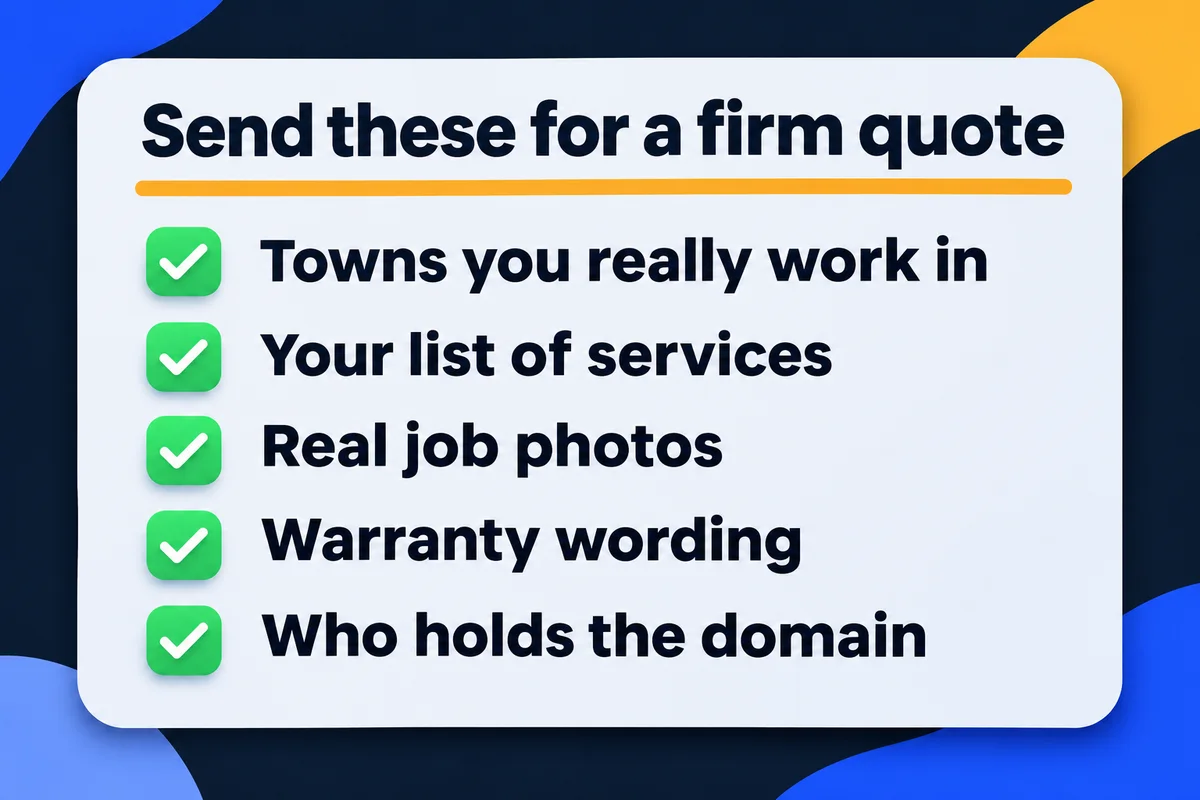
Quotes drift when nobody wrote down what was in them. Mine is fixed in writing before any work starts, and it gets there faster when I've got these five things:
- The towns you really work in, sorted by whether they pass the test above.
- Your services, in the words your customers use on the phone.
- Real job photos. A blurry photo of your own truck beats a stock photo of a man pointing at shingles.
- Your warranty wording, exactly as it appears on your contract.
- Who holds the domain today. If the answer is "the guy who did the site", read who owns your website before anything else.
Why US pricing guides show bigger numbers
You'll find US guides quoting $2,500 to $10,000 and $2,200 to $18,000 for a roofing website. Those are US dollars for the US market, with their own scope. When you compare any two quotes, line them up by page count first and by what's written into the price. For the wider picture beyond roofing, I've got a guide to what a website costs in the GTA.
Short answers on roofing website prices
Is $899 enough for a roofing company website?+
If your count comes to 10 pages or fewer, yes. That covers a one-crew company in one town with a home page, roof types, a gallery and a contact page. A blog section starts on the $1,499 line.
How much does an HVAC website cost compared to a roofing one?+
My price list is the same for both, because it goes by pages and features. I haven't measured HVAC sites the way I measured these roofers. The HVAC website page shows how a heating company's site is laid out.
Should a roofer use WordPress or a hand-coded site?+
12 of the 16 home pages I read run on WordPress. I'd decide on one question: will you edit the site yourself? If yes, WordPress. If you'd rather call someone, a coded site is faster and cheaper to keep running.
How long does a roofing website take to build?+
About 5 to 7 days once your photos and service details are ready. The waiting is usually on the text and photos, so gather them over a rainy week when the crew isn't on a roof.
Who owns a roofing website once it's paid for?+
The roofer does, and it should say so on the quote. With me, the domain and hosting sit in your own name, and stopping a monthly plan leaves the site where it is. Ask any builder the same question before you pay a deposit.
Sources, read on 5 November 2026: public sitemaps and home pages of 16 Ontario roofing companies, read by me one at a time with pauses between requests; Google, Spam policies for web search; WSIB, Clearances. Prices are from my own pricing page, in Canadian dollars.
Got a page count and a town list?
Send them to me with your website address, and you'll get a fixed price in writing before any work starts.
Get My Free Quote
I hand-code websites for service businesses around the GTA, and I publish my prices so you can do the sum yourself before you ever call me. Read my full bio · Get in touch